
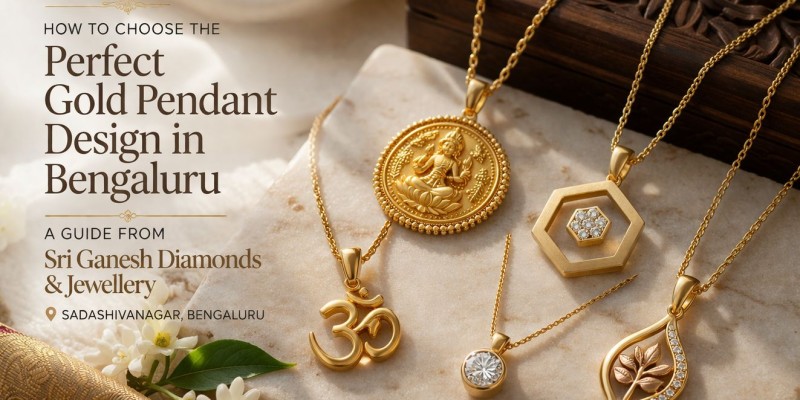
How to Choose the Perfect Gold Pendant Design in Bengaluru – A Guide from Sri Ganesh Diamonds & Jewellery, Sadashivanagar
Ask anyone in Bengaluru about their first piece of gold jewellery, and chances are good it was a pendant. A small Lakshmi coin passed down at a naming ceremony. A tiny Om on a simple chain gifted on a birthday. A diamond solitaire received as an engagement gift. Pendants have a way of collecting meaning. They sit close to the chest for a reason.
But when it comes to actually choosing one, people freeze. The options are genuinely overwhelming. 22 karat or 18 karat? Temple design or geometric? With diamonds or without? Long chain or short? And underneath all of that, the practical question that nobody quite says out loud: will this still look good in ten years, or is it going to feel dated in two?
This guide is for anyone standing at that crossroads. Whether you are buying gold jewellery in Bangalore for the first time, or you have been collecting pieces for years and want to be more intentional about the next addition, we will walk you through every decision that matters. No filler, no vague advice. Just a clear framework for choosing a gold pendant design you will actually wear, love, and keep.
A pendant is often the most personal piece in a jewellery collection. It gets chosen for a reason, worn close to the body, and passed on with a story. Getting it right matters.
Why Gold Pendants Hold a Special Place in Indian Jewellery Culture
Gold pendants are not a new idea. Across South India and across centuries, the pendant has been a central piece of jewellery for women and men. The Lakshmi coin pendant worn at weddings. The Ganapati locket given to children. The Om pendant worn by men who would rarely touch any other jewellery. These pieces carry meaning that goes well beyond aesthetics.
What has changed in recent years is the range. The traditional forms are still very much alive at jewellery stores in Bangalore, and they should be. But alongside them, a new vocabulary of gold pendant design has emerged: layered geometric pieces, nature-inspired motifs worked in 18 karat rose gold, solitaire diamond pendants on delicate chains, convertible designs that can be worn short or long depending on the outfit.
The result is that today’s buyer in Bengaluru is not choosing between tradition and modernity. They are choosing how much of each they want, and in what proportion. That is actually a more interesting problem, and it is why a structured approach to the decision helps.
The Pendant as Investment
Unlike most jewellery categories, a pendant sits at an interesting intersection. It is small enough to be affordable at almost any budget. It is personal enough to be meaningful. And because the design is usually simpler than a necklace or a set, the gold-to-making-charge ratio is often more favourable than larger pieces.
A well-chosen pendant in 22 karat gold holds its value reliably. As of early 2025, gold prices in India have been trading near historic highs, crossing Rs 90,000 per 10 grams at various points. A pendant bought five years ago at Rs 50,000 has likely appreciated considerably in raw material value alone, even before accounting for the craftsmanship.
This does not mean every pendant purchase is a financial decision. Most are not. But it is worth knowing that a quality gold pendant, bought from a reputable jeweller with proper BIS hallmarking, is not a purely sentimental expenditure. The gold inside it is real, its purity is certified, and it will hold value over time.
The First Decision: 22 Karat or 18 Karat Gold?
This is the question that trips up most first-time buyers, and it deserves a direct answer rather than a diplomatic one.
22 Karat: Higher Purity, Better Investment Value
22 karat gold is 91.6% pure gold, with the remaining 8.4% made up of other metals, usually copper and silver, which give it just enough strength for everyday jewellery. This is the standard for traditional Indian gold jewellery. Temple pendants, Lakshmi coins, religious motifs, and most South Indian traditional designs are made in 22 karat.
If you are buying a pendant that will double as a long-term investment, that will be passed down, or that needs to hold maximum resale value, 22 karat is the right choice. The colour is a richer, deeper yellow than lower karat gold. It looks distinctly Indian in the best possible way, and it holds cultural resonance that 18 karat simply does not carry in the same way.
The trade-off is design complexity. 22 karat gold is relatively soft. Very fine filigree work, thin geometric shapes, or pieces with sharp edges are harder to produce reliably in 22 karat without compromising durability.
18 Karat: More Design Flexibility, Better for Contemporary Styles
18 karat gold is 75% pure, with 25% alloys. That higher alloy content gives jewellers considerably more design freedom. Fine detail work, architectural shapes, and modern geometric designs are all easier to achieve in 18 karat. The alloys can also be adjusted to produce rose gold and white gold, which are not achievable in 22 karat without significant colour change.
For professionals who want a pendant that goes from office to dinner without looking like festival jewellery, 18 karat is usually the answer. A slim bar pendant, a bezel-set diamond solitaire, a geometric hexagonal design in brushed gold: these work beautifully in 18 karat.
The investment value is lower per gram than 22 karat because there is less actual gold. But for pieces you plan to wear daily rather than hold as an asset, that trade-off is entirely reasonable.
A Practical Rule of Thumb
Traditional motifs, religious significance, heirloom quality: choose 22 karat. Contemporary designs, daily-wear office jewellery, rose gold or white gold: choose 18 karat. If you are unsure, the team at Sri Ganesh Diamonds & Jewellery in Sadashivanagar can show you examples of the same design in both karats, which is the clearest way to make the decision.
Gold Pendant Design Styles: Finding the One That Is Actually Yours
There are dozens of pendant categories. Here are the ones that matter most for buyers in Bengaluru, with honest guidance on who each suits.
1. Traditional and Temple Pendants
These are the designs rooted in South Indian temple iconography. Goddess Lakshmi, Lord Ganapati, Lord Venkateshwara, peacock motifs, mango (maavilai) shapes, lotus forms. These pendants are typically made in 22 karat yellow gold, often with kempu (glass stone) settings or enamel work in red and green.
Traditional pendants work brilliantly for festival wear, religious occasions, and as family heirlooms. Many buyers in Sadashivanagar and across Bengaluru choose these specifically because they want something that carries cultural weight, not just visual appeal.
The important distinction here is between genuinely crafted traditional pieces and mass-produced versions that look similar but lack the quality of execution. At Sri Ganesh Diamonds & Jewellery, the traditional collection is handcrafted, which means the detailing on a Lakshmi pendant is precise rather than approximate. That difference is visible.
2. Diamond Pendants
A diamond pendant is probably the most versatile piece of jewellery a woman can own in 2025. A well-chosen solitaire or a small cluster in a simple setting works with a salwar kameez, a saree, a blazer, and a dress. No other pendant crosses that many contexts as cleanly.
The key decisions within this category are the setting style and the gold type. A bezel setting, where the diamond is completely surrounded by a rim of gold, gives a sleek modern look and holds the stone securely. A prong setting, where thin gold claws hold the diamond, lets more light through the stone and gives a more traditional fine jewellery appearance.
For diamond pendants, always ask for the grading certificate. At Sri Ganesh Diamonds & Jewellery, every diamond piece comes with certification confirming the cut, clarity, colour, and carat weight. This is not optional. A diamond without a certificate is a diamond whose quality you cannot verify.
Rose gold settings have become popular for diamond pendants over the past few years, particularly for gifting. The warm tone of rose gold against a white diamond creates a softer, more romantic look than yellow or white gold.
3. Geometric and Contemporary Pendants
Thin gold bars, hexagonal forms, interlocking circles, asymmetric shapes, layered geometric pieces. This is the category that has grown most quickly in urban India over the past decade, and Bengaluru’s professional population is a big part of why.
Geometric pendants work in 18 karat gold because the cleaner lines of lower-purity gold suit the precision of geometric forms. They also tend to be lighter in weight, which matters for everyday wear. A pendant you forget you are wearing by 11am is a pendant you will actually reach for every morning.
The styling logic here is simplicity. A geometric pendant looks its best on a plain chain, with no other necklaces competing for attention. Layer it if you want, but keep the layers thin and the lengths intentionally staggered.
4. Nature-Inspired Pendants
Floral motifs, leaf forms, teardrop shapes, feathers, peacocks rendered in a more contemporary way than traditional temple work. These sit between traditional and geometric, and they work across a wider range of contexts than either.
A delicate floral pendant in 22 karat gold pairs easily with traditional attire. The same design in 18 karat rose gold works for casual and semi-formal western wear. Nature motifs have a visual logic that most people respond to instinctively, which is why this category has always been popular and continues to be.
5. Personalised and Custom Pendants
Initial pendants, name pendants, coordinate pendants, pendants designed around a specific meaningful symbol. These have been growing in popularity across India and they are now accessible in quality gold rather than just gold-plated versions.
Sri Ganesh Diamonds & Jewellery handles custom pendant orders regularly. A customer can come in with a specific idea, whether it is a family deity rendered in a contemporary way, an initial in a particular font, or a design inspired by something personal, and the team of artisans will translate that into a finished piece. Custom engagement ring orders at the store have been completed in as little as seven days, which gives a sense of the execution speed.
Custom work requires clear communication and ideally a sketch or reference image. The team can also generate design options based on a brief, which is useful for customers who know what they want but cannot quite articulate it.
Choosing the Right Gold Pendant Design for Your Occasion
A single pendant cannot do every job. Here is a practical mapping of design styles to occasions:
| Occasion | Best Pendant Style | Recommended Karat |
|---|---|---|
| Daily office wear | Geometric / Solitaire diamond | 18K yellow or rose gold |
| Festive / Pooja | Temple / Traditional motif | 22K yellow gold |
| Wedding (bride) | Statement temple or diamond set | 22K or 18K white gold |
| Wedding (guest) | Nature motif or diamond | 18K or 22K |
| Gifting | Personalised / Initial / Solitaire | 18K rose gold |
| Casual / Weekend | Geometric bar or simple charm | 18K any tone |
| Heirloom / Investment | Traditional deity or coin | 22K yellow gold |
This is a guide, not a rule. Many customers at Sri Ganesh Diamonds & Jewellery in Sadashivanagar choose temple pendants for daily wear because they have personal significance that outweighs styling convention. That is entirely valid. The table above is a starting point for people who are uncertain, not a constraint for people who already know what they want.
The Chain Question: It Is Not an Afterthought
A pendant without the right chain is like a picture frame without the right mounting. The chain is not the supporting actor. It is co-equal to the pendant, and the combination of the two determines how the overall piece looks and sits on the body.
Chain Length and Neckline
The standard chain length for most pendants sold in India is 18 inches. This sits just below the collarbone on most women and is the most versatile length for office and casual wear. A 16 inch chain sits at the collarbone, working well for V-necks and scoop necks. A 20 to 22 inch chain drops below the collarbone, which suits high necklines and allows the pendant to be visible even with a collar or dupatta.
A simple rule: the higher the neckline of your most commonly worn clothing, the longer the chain should be. If you wear sarees regularly, a longer chain keeps the pendant visible over the blouse. If you mostly wear western formal wear, 18 inches is usually right.
Chain Style and Pendant Weight
Heavier pendants, particularly traditional temple designs in 22 karat gold, need chains with structural integrity. A rope chain or a box chain holds the weight cleanly without twisting or kinking. Fine Franco chains or herringbone chains work beautifully for lighter pendants, particularly geometric designs in 18 karat.
A curb chain, which has flat interlocking links, is the most versatile option across pendant weights and styles. It works with traditional pendants, contemporary designs, and everything in between. Many customers who are unsure about chain style default to a curb chain, and it is rarely a wrong choice.
Matching Gold Tone Across Pendant and Chain
The gold tone of the chain and pendant should match unless you are deliberately layering mixed metals, which is a specific styling choice that requires confidence to pull off well. A rose gold pendant on a yellow gold chain looks like a mismatch unless the layered mixed-metal look is intentional and the rest of your jewellery supports it.
At Sri Ganesh Diamonds & Jewellery, chains and pendants are shown together during consultation, which solves this problem practically. The team will suggest combinations and let you try them before committing.
What to Check Before You Buy: A Practical Checklist
Walking into a jewellery store with this checklist in mind will make the visit considerably more productive.
Verify the BIS Hallmark
Since 2021, the Bureau of Indian Standards has made BIS hallmarking mandatory for all gold jewellery sold by registered jewellers in India. Every hallmarked piece carries the BIS logo, the purity figure (916 for 22 karat, 750 for 18 karat), and a six-digit Hallmark Unique ID (HUID) that can be verified on the BIS Care app. This is the single most important quality check for a gold pendant purchase.
At Sri Ganesh Diamonds & Jewellery, every gold piece is BIS hallmarked and full documentation is provided with purchase. If a jeweller cannot show you the hallmark on a piece, that is a reason to walk away.
Ask About Making Charges Upfront
Making charges on a pendant typically range from 8% to 18% of the gold value, depending on the complexity of the design. Intricate temple pendants with hand-engraving or stone settings will be at the higher end. Plain geometric designs are at the lower end. These charges are not recovered on resale, which is worth knowing if you are buying with investment in mind.
Ask the jeweller to show you the making charge as a separate line item before finalising the purchase. Reputable stores do this as standard. It lets you compare prices across jewellers on an apples-to-apples basis.
For Diamond Pendants: Insist on the Certificate
A GIA or IGI grading certificate for a diamond pendant tells you the exact cut, colour, clarity, and carat weight of the stone. Without it, you are buying based on the seller’s description rather than a third-party assessment. Sri Ganesh Diamonds & Jewellery provides certificates for all diamond pieces.
Check the Clasp and Bail
The bail is the loop or mechanism through which the pendant attaches to the chain. A poorly designed bail can rotate, causing the pendant to flip to the back of the chain. A good bail keeps the pendant facing forward. Before purchasing, thread the pendant onto a chain and check that it hangs straight and does not rotate. The clasp of the chain should open and close smoothly without requiring tools.
Consider Wearability, Not Just Appearance
Try the pendant on with the chain at the correct length. Check whether the weight distribution is comfortable. If it is a large traditional pendant, assess whether the bail and chain can carry the weight over several hours of wear. A pendant that looks striking on the display stand but causes neck discomfort after two hours is not serving you.
Gold Pendant Design Trends Worth Knowing in 2025
Trends are worth knowing without being enslaved to them. Here is what is currently popular among buyers of gold jewellery in Bangalore and what that popularity reflects about changing tastes.
Layered Pendants and the Multi-Chain Look
Wearing two or three chains at different lengths, with pendants of different sizes, has become widespread among Bengaluru’s professional and fashion-conscious population. The layering logic: one fine chain with a small geometric or initial pendant, one slightly longer chain with a modest solitaire, and sometimes a third with a coin or disc. The result is intentional complexity rather than a single focal point.
This trend favours 18 karat gold and lighter pendants because the weight of multiple chains needs to be manageable for daily wear.
Rose Gold Has Sustained Its Popularity
Rose gold had what looked like a moment around 2015 to 2018. That moment has not ended. Rose gold pendants, particularly for diamond designs and nature-inspired motifs, continue to be among the most popular choices for gifting and self-purchase among women in the 25 to 45 age group. The warm tone photographs well, which matters more now than it used to.
Antique and Oxidised Finishes
The matte, aged look of antique-finish gold pendants has been growing steadily. These pieces have a texture and depth that polished gold does not, and they suit traditional Indian outfits particularly well. Antique-finish Lakshmi pendants, kempu-set temple designs, and oxidised coin pendants are all seeing strong demand in Sadashivanagar and across Bengaluru’s jewellery market.
Minimal Everyday Pendants
Thin bar pendants, small disc pendants with a single engraved letter, tiny teardrop shapes, simple Om or Ganapati charms in 18 karat. This category of minimal everyday pendants has grown significantly as more women build jewellery wardrobes rather than buying only for occasions. A minimal pendant that lives permanently around the neck is a different purchase decision than a statement piece brought out for events.
Why Buying from a Trusted Jewellery Store in Bangalore Matters
Online shopping for gold jewellery has grown, and for some categories it makes sense. But for a pendant, where the decision involves weight, proportion, how a stone sits in its setting, and how the piece feels against your skin, there is no substitute for seeing and touching the actual piece.
The Showroom Advantage
When you visit a jewellery store in person, you can see the pendant under multiple lighting conditions, which matters because gold changes colour significantly between LED spotlights and natural light. You can test the chain length against your own neckline. You can ask the consultant to show you the pendant with alternative chains or alongside other pieces you are considering. These are decisions that cannot be made from a photograph.
For custom pendant orders specifically, an in-person consultation is essential. The ability to show a reference image, discuss proportions using actual pieces as reference, and see design sketches or mockups before the gold is worked, results in a final piece that is closer to what you actually wanted. Sri Ganesh Diamonds & Jewellery handles custom orders regularly, and the consultation process is designed to make that precision achievable.
What Sri Ganesh Diamonds & Jewellery Carries
Sri Ganesh Diamonds & Jewellery is located at 25, Sankey Road, 2nd Main Road, near the Citibank ATM, Sadashivanagar, Bengaluru 560080. The store carries gold jewellery across the full range: earrings, necklaces, bangles, rings, chains, and pendants in both 22 karat and 18 karat gold. Diamond jewellery with certified stones is a significant part of the collection, including pendant designs ranging from classic solitaires to more complex cluster and halo settings.
What the store does not carry: silver pendants, gold-plated or fashion jewellery, or mass-produced pieces without hallmarking. Every piece sold is hallmarked, documented, and backed by a transparent pricing structure that breaks out gold weight, making charges, and stone costs separately.
Custom pendant orders are taken with a consultation, and the team has delivered custom engagement ring designs in as little as seven days. Pendant customisation timelines are similar for most designs.
The right jeweller does not just sell you a pendant. They help you understand why one choice is better than another for your specific situation, and they stand behind the quality of what they sell.
Frequently Asked Questions
What is the best gold karat for a pendant that I will wear daily?
For daily wear, 18 karat gold is generally the better choice. It is harder and more durable than 22 karat, holds its shape better under the wear of everyday movement, and offers more design variety in contemporary styles. If the pendant has religious or cultural significance and you want maximum gold content and resale value, 22 karat is the right choice despite the slightly softer metal.
How do I know if a gold pendant is genuinely hallmarked?
Look for the BIS logo, the purity figure (916 for 22K, 750 for 18K), and the six-digit HUID code on the pendant. You can verify the HUID on the BIS Care mobile app, which will confirm the registered jeweller, assay centre, and purity. At Sri Ganesh Diamonds & Jewellery, all pieces are BIS hallmarked and the documentation is provided with purchase.
What is a reasonable making charge for a gold pendant?
Making charges typically range from 8% to 18% of the gold value for pendants. Simple geometric or plain designs are at the lower end. Intricate temple designs, stone-set pieces, and handcrafted work are at the higher end. Always ask for the making charge as a separate line item so you can compare across jewellers on a consistent basis.
Can I get a custom pendant made at Sri Ganesh Diamonds and Jewellery?
Yes. Custom pendant orders are a regular part of the work at Sri Ganesh Diamonds & Jewellery in Sadashivanagar. Customers can bring a reference image, describe a concept, or ask the design team for options based on a brief. Most custom pendant designs are completed within a week to ten days. Call ahead on +91 9535865482 or +91 9740255109 to schedule a consultation.
Which pendant style works best for gifting?
For gifting, the most universally wearable options are a solitaire diamond pendant in 18 karat rose gold, an initial or name pendant in 18 karat gold, or a simple nature-inspired motif in yellow or rose gold. These are personal without being too specific, beautiful without being ostentatious, and work for a wide age range. If you know the recipient’s style well, a pendant in the category they tend to wear is always the better choice.
How do I care for a gold pendant?
Gold does not tarnish, but it does attract oils, lotions, and surface dirt that dull its shine over time. Clean a gold pendant gently with a soft cloth and mild soap in warm water, rinse well, and dry completely before storing. Store pendants separately from other jewellery to prevent scratching. Remove your pendant before swimming, exercising, or applying perfume or lotions. A quick clean every few weeks keeps the piece looking as good as the day you bought it.
Final Thoughts
Choosing a gold pendant design in Bengaluru should not be an overwhelming process, but it often feels that way because the options are genuinely wide and the decision feels permanent. The good news is that a well-chosen gold pendant is not a decision you will regret. Gold holds its value. Good design holds its appeal. And a pendant that means something to you will keep meaning something to you, regardless of what comes in and out of fashion.
The framework in this guide comes down to a few clear questions. What karat suits your purpose and budget? What design style fits your wardrobe and the occasions you are buying for? What chain complements the pendant rather than competing with it? And which jeweller can show you hallmarked pieces with transparent pricing and stand behind the quality of what they sell?
In Sadashivanagar, the answer to that last question is Sri Ganesh Diamonds & Jewellery, at 25, Sankey Road, 2nd Main Road, near Citibank ATM. Walk in, ask questions, try pieces on, and take the time the decision deserves. You can also call ahead on +91 9535865482 or +91 9740255109 to book a consultation, particularly useful for custom pendant orders.
The pendant you choose carefully and wear with intention will outlast every trend, accumulate meaning over years, and become the piece someone else admires and asks about. That is worth getting right.